How Do You Know Youve Selected the Right Frame in Indesign Adobe
Equitable Linguistic communication: We are replacing non-inclusive language from InDesign 2022 (version 17.0) onwards, to reflect cadre Adobe values of inclusivity. Any reference to Chief page is replaced by Parent folio in our Help articles for the English, Danish, Hungarian, Spanish, Italian, Brazilian, Portuguese, and Japanese locales.
Overview of choice methods
InDesign provides the following option methods and tools:
Selection tool

Allows y'all to select text and graphics frames, and work with an object using its bounding box. If you click the content grabber (the donut) that appears when y'all hold the mouse pointer over an image, you can dispense the image within the frame without switching to the Direct Option tool.

Directly Selection tool

Allows y'all to select the contents of a frame, such as a placed graphic, or piece of work straight with editable objects, such every bit paths, rectangles, or blazon that has been converted to a text outline.
Type tool

Allows you to select text in a text frame, on a path, or in a table.
Select submenu
Allows you to select an object's container (or frame) and its contents. The Select submenu as well lets you select objects based on their position relative to other objects. To view the Select submenu, choose Object > Select. You can too right-click (Windows) or Control-click (Mac Bone) an object to display its context carte, and and then cull Select.
Select buttons on the Command panel
Lets y'all the select the content using the Select Content push button or the container using the Select Container push
 . You lot tin likewise utilize the Select Next Object or Select Previous Object to select the adjacent or previous objects in a group or on a spread.
Select All and Deselect All commands
Let you lot to select or deselect all objects on the spread and pasteboard, depending on which tool is active and what is already selected. Choose Edit > Select All or Edit >Deselect All.
Double-click an object to switch between the selecting the frame and the object. Double-click a text frame to place the insertion point and switch to the Type tool.
Select objects
An object is any printable element on a page or on the pasteboard, such every bit a path or an imported graphic. A frame or path is a shape you draw or a container for text or graphics. A bounding box is a rectangle with eight selection handles that represents an object'south vertical and horizontal dimensions. Earlier yous can modify an object, yous must select information technology using a selection tool.
There are two means to select an object in InDesign:

-
You can employ the Selection tool
to select the object's bounding box for performing full general layout tasks, such as positioning and sizing objects. When selecting an image, you can apply the Choice tool to select either the frame or the image within the frame.

A. The content grabber appears when yous mouse over an paradigm.B. Click the content grabber to select the contents.C. Click outside the content grabber to select the frame.
-
You tin can use the Direct Selection tool
to select the contents of a container (such equally an imported graphic) or individual points on a path for tasks involving resizing imported graphics, drawing and editing paths, and editing text.
An imported graphic is always contained inside a frame. It'due south possible to select the graphic and its frame, the graphic only, or its frame only. The frame and bounding box of an imported graphic can be unlike sizes. To see how InDesign indicates what's selected, see Modifying objects using graphics frames.

With rectangular objects, it can exist difficult to tell the divergence between the object's bounding box and the path of the object itself. A bounding box always displays 8 big hollow anchor points. A rectangular path always displays four small anchor points (which can be hollow or solid).
Select a bounding box
For any object, you tin can select its bounding box—a rectangle that represents the object'due south horizontal and vertical dimensions. (For grouped objects, the bounding box is a dashed rectangle.) The bounding box is also called a container. The bounding box makes it possible to apace motion, indistinguishable, and scale the object without having to utilize whatever other tool. For paths, the bounding box makes it like shooting fish in a barrel to work with an unabridged object without accidentally altering the anchor points that make up one's mind its shape.
For more precise moving and scaling, and for other modifications such every bit rotation, utilize the Control console or the Transform panel.
-
Using the Pick tool
, practise one of the following: -
Click the object. If the object is an unfilled path, click its edge. If the object is an image, click the content grabber to select the bounding box of the image, or click exterior the content grabber to select the frame.
-
Drag a dotted selection rectangle or marquee effectually part or all of the object.
-
With a graphic object or nested content selected, click the Select Container button
on the Command panel.
-
When you select 1 or more objects with the Selection tool, you come across a bounding box that indicates the size of each object. If you don't see a bounding box when an object is selected, you may have selected the object using the Direct Selection tool.
If you lot click a frame and it is non selected, the frame may be a locked item, information technology may be on a locked layer, or it may be a parent page item. Run across Unable to select objects.
Select a path or points on a path
Paths in InDesign are defined past anchor points, stop points, and direction lines. You select anchor points and cease points using the Directly Option tool.

-
Using the Direct Selection tool
, click the path to select it. Detect how the tool changes when it's in a higher place a path
 or a signal
 .
. -
-
To select an individual point, click it.
-
To select multiple points on the path, press Shift as you lot click each signal.
-
To select all of a path's points at once, click the point at the center of the object, or concord down Alt (Windows) or Pick (Mac OS) and click the path. If you lot direct-select any office of the object, the Select All command also selects all the points.
-
Select text inside a frame
- To select text by dragging, click on a text frame using the Type tool. An insertion bespeak appears.
- To create an insertion point in text, double-click a text frame using any selection tool. InDesign switches to the Type tool automatically.
Select an object within a frame
-
-
Click the object using the Direct Selection tool
. The Direct Choice tool automatically changes to the Hand tool when placed over a graphic object inside a frame (but non when placed over a non-graphic object, such equally a path). -
If the object inside a frame is an image, click the content grabber to select the paradigm.
If you don't want the content grabber to appear when you hover over an image, choose View > Extras > Hibernate Content Grabber.
- With a frame selected, choose Select > Content from the Object carte or the frame'due south context card.
- With a frame selected, click the Select Content push button on the Control console.
-
Select multiple objects
- To select all the objects in a rectangular surface area, apply the Selection tool to elevate a marquee over the objects you want to select.
- To select nonadjacent objects, use the Selection tool to select an object and then printing Shift every bit you click boosted objects. Clicking selected objects deselects them.
- To add more objects to a selection, press Shift every bit you utilise the Selection tool to drag a marquee over additional objects. Dragging over selected objects deselects them.
You tin can use these same techniques with the Direct Selection tool to select objects nested inside groups or frames.
Select or deselect all objects
To deselect all objects on the spread and its pasteboard, choose Edit >Deselect All. Or, with the Selection tool or Direct Selection tool, click at to the lowest degree 3 pixels away from any object.
The Select Allcontrol has a different effect depending on the state of affairs:
-
If the Selection tool
is agile, all paths and frames on the spread and pasteboard are selected, with their bounding boxes active. -
If the Directly Selection tool
is active and an object is direct-selected, Select All selects all the ballast points of that object but does non select any other object. If nothing is selected, Select All selects all the path objects on the spread and pasteboard. -
If the Type tool is active and there is an insertion point in a text frame (indicated by a flashing vertical line), Select All selects all text in that text frame and whatsoever text frames threaded to it, but selects no other objects.
-
If an object in a group is selected, Select All selects the rest of the objects in the group but no other objects on the spread.
-
Select the tool you lot desire to apply. If desired, select an object or identify the insertion point in a text frame.
-
Choose Edit > Select All.
The Select All command doesn't select nested objects, objects that are positioned on locked or hidden layers, parent page items that are not overridden on certificate pages, or objects on other spreads and pasteboards (except for threaded text).
Unable to select objects
Non being able to select an object may exist the result of the following issues:
-
The object is covered by some other object in a stack. Hold down Ctrl (Windows) or Command (Mac Bone), and then click the same identify repeatedly until you've selected the frame or group you want. See Select nested or overlapping objects.
-
The object is a parent page item, as indicated past a dotted border. To select a parent folio item, either plow to the parent page that is applied to the certificate page, or override the parent page item. Run into Override a parent item.
-
The object is locked using the Object > Lock command. Choose Object > Unlock All On Spread. See Lock or unlock objects.
-
The object is on a locked layer. Click the lock icon side by side to the layer in the Layers console to unlock the layer. See Lock or unlock layers.
Select nested or overlapping objects
When a frame contains an object, the contained object is said to be nested inside a container, or frame. Three common kinds of nesting are: paths inside frames, frames inside frames, and groups inside groups. Always be aware of exactly which objects or object attributes yous demand to select, which ones are currently selected, and which selection tools to use to modify selections.
Y'all control selections in nested groups using the Direct Selection and Option tools, as well as the Select Content and Select Container buttons. Y'all can select text characters using the Blazon tool at any time, no thing how securely a text frame is nested.
Select nested, grouped, or overlapping objects
When you nest objects or identify objects on top of each other on the same layer, it tin can be difficult to select a single object or frame. The Object menu and context menu contain selection options to make it easier to select the object you lot want.
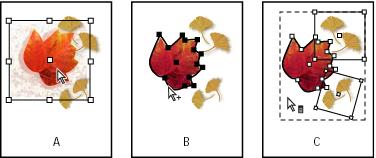
A. Image selectedB. Path of the frame containing the image is selectedC. Grouping containing frame selected
Opening the Info panel makes it easier to see which object is selected.
-
Using the Directly Selection tool
, click the nested or grouped object. -
If you tin can't select the object you want, use ane of the following techniques:
- Cull Object > Select, and cull one of the pick options.
- Position the pointer over the object you want to select and correct-click (Windows) or Control-click (Mac OS) to display the context carte. And then choose Select and the desired selection option.
Selecting objects using the context menu commands is not the same as using the Object > Select menu commands. From the context menu, the selections are based on the exact signal where you clicked to display the context menu. This means that the next object above or beneath the mouse click would be selected, rather than the next object in the stacking lodge.
-
Hold down Ctrl (Windows) or Command (Mac Os), so click the same place repeatedly until you lot've selected the frame or group yous desire. (Practise not click an anchor betoken.)
-
To select all objects in a group individually, utilize the Selection tool to select the group, click the Select Content button
on the Control console, and then choose Edit > Select All.
-
To progressively drill down or up through a stack of objects, do 1 of the following:
-
Right-click (Windows) or Control-click (Mac Os), so choose an option from the Select context carte.
-
Choose Object > Select > Next Object Below or Next Object Above repeatedly until the object yous want is selected. When you achieve the beginning or finish of the stack, the selection doesn't alter.
-
Concur down Ctrl (Windows) or Command (Mac OS) and click the stack to drill down from the meridian of the stack. When you lot attain the cease of the stack, the selection starts over at the top of the stack. To drill upwards from the lesser of the stack, hold downwardly Alt+Ctrl (Windows) or Option+Command (Mac OS) and click the stack using the Pick tool.
The context menu options are sensitive to the location of the pointer.
-
Select multiple nested objects
-
Using the Direct Choice tool
, click the nested object. -
Concur downward Shift equally you click each boosted nested object y'all want to select.
Selection options
Options on the Select submenu (cull Object > Select or cull Select on the context menu) help you select overlapping, nested, or grouped objects. The availability of some options depends on the type of objects you're working with. When using the context menu, the object selected depends on the position of the pointer.
First Object Above
Selects the object at the summit of the stack.
Adjacent Object Above
Selects the object only to a higher place the current object.
Next Object Below
Selects the object just below the current object.
Last Object Below
Selects the object at the bottom of the stack.
Content
Selects the content of the selected graphics frame, or, if a grouping is selected, selects an object within the group. Yous can also click the Select Content button in the Command panel.
Container
Selects the frame enclosing the selected object, or, if an object within a group is selected, selects the group that contains information technology. You can also click the Select Container button in the Control console.
Previous Object / Next Object
Selects the next or previous object in the grouping if the selected object is part of a group, or, if an ungrouped object is selected, selects the next or previous object on the spread. Shift-click to skip by five. Ctrl-click (Windows) or Command-click (Mac OS) to select the first or last object in a stack.
Arrange objects in a stack
Overlapping objects are stacked in the lodge in which they are created or imported. You can use the Arrange submenu to modify the stacking order of objects.
The Layers panel as well helps determine the stacking social club of objects. The order of each layer in the Layers panel determines whether objects in a layer appear in front of or behind objects on other layers. The lodge of objects within each layer determines the stacking guild of those objects within that layer. Yous can drag the objects inside a layer or use the Object > Adapt menu commands to control stacking within each layer. If you haven't created any layers, your certificate contains just one stack of objects on the unmarried default layer. Objects on parents be at the back of each named layer.
Grouping objects might modify their stacking society (in relation to ungrouped objects).
-
Select the object you want to move forward or backwards in a stack.
-
-
To move a selected object to the front or dorsum of a stack, choose either Object > Arrange > Bring to Front or Object > Conform > Ship to Back.
-
To move a selected object forward or astern past the side by side object in a stack, choose either Object > Arrange > Bring Forward or Object > Arrange > Send Astern.
-
In the Layers console, click the disclosure triangle next to a layer, and so drag objects within the layer to change their stacking gild.
-
Source: https://helpx.adobe.com/indesign/using/selecting-objects.html
0 Response to "How Do You Know Youve Selected the Right Frame in Indesign Adobe"
Post a Comment